




































by Andy Gray published on November 2nd, 2011
The folks at the Center for Electromechanics at University of Texas at Austin (UT-CEM) are doing some neat simulation projects with power systems, and we were honored to learn that NMath is at the core of their CEM Solver software. CEM Solver demonstrates substantial performance improvements over SimPowerSystems, reducing simulation time for a typical example…
keep reading...
Posted in Case Studies, NMath | No Comments »
by Ken Baldwin published on October 5th, 2011

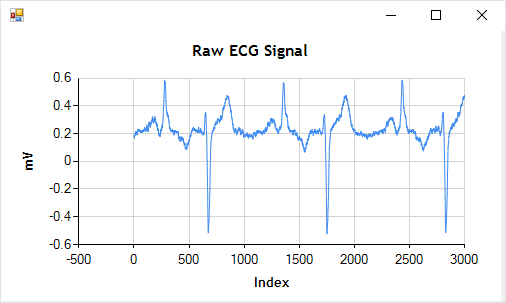
With the most recent releases of NMath 5.1 and NMath Stats 3.4, creating charts from our class types is easy with new adapter classes. These classes use the .NET Microsoft Chart Controls for visualization, and allow for complex customization or simple data visualization with one line of code.
keep reading...
Posted in NMath, NMath Stats, Visualization | No Comments »
by Ken Baldwin published on September 30th, 2011
The NMath Chart DLLs (NMathChartMicrosoft.dll and NMathStatsChartMicrosoft.dll) are built against the .NET 3.5 version of the Microsoft Chart Controls for .NET (System.Windows.Forms.DataVisualization). The .NET runtime will not automatically replace this reference with the version of the Microsoft Chart DLL built into the .NET 4.0 Framework, unless you explicitly tell it to do so by adding the…
keep reading...
Posted in NMath, NMath Stats, Visualization | No Comments »
by Ken Baldwin published on September 27th, 2011
CenterSpace is proud to announce the immediate availability of new versions of our .NET math libraries, NMath 5.1 and NMath Stats 3.4. This release adds many new features and performance enhancements. Version 5.1 of NMath adds: Assembly NMathChartMicrosoft.dll containing class NMathChart, which provides static methods for plotting NMath types using the Microsoft Chart Controls for .NET. [More]…
keep reading...
Posted in NMath, NMath Stats | No Comments »
by Ken Baldwin published on August 9th, 2011
We were recently contacted by a customer looking for help on how to use NMath to fit geometric primitives to clouds of 2D points. The solution is to cast the problem as a minimization. In the space of the parameters which define the geometric object, minimize the residuals with respect to the 2D points. NMath…
keep reading...
Posted in NMath Tutorial | No Comments »